


.svg)
.svg)
.svg%201.svg)



Get Business Email
No domain name required
Get Finance Email Address
Email with Free Domain & Site

Key Takeaways
- The right setup for a small business's finance email: Neo Mail is the pick for financial firms with smaller teams of 1 to 10, because every plan includes aliases and a free domain if you need one. It starts at $1.25 per mailbox per month on the 4-yearly plan, with a 15-day free trial.
- For larger financial companies: Microsoft 365 is right when several staff share one mailbox. Google Workspace is right for teams in Google's apps. Proton Mail is right when end-to-end encryption matters most.
- How many finance addresses a small business needs: Start with finance@yourbusiness.com and invoices@yourbusiness.com. Add payroll@yourbusiness.com and ar@yourbusiness.com only when one inbox gets too busy for one owner.
- Two mistakes people make when setting up finance email addresses: They mix money in and money out in one inbox. They also change bank details because an email asked. Split payables from receivables, and confirm bank changes by phone.
What Is a Finance Email Address?
A finance email address is a role address, such as finance@yourbusiness.com, that handles invoices, payments and money questions for a business. It belongs to the finance function, not to one person.
A small business can run its finance address as an alias, with no extra mailbox to pay for. Real examples come first, because vendors copy these addresses into their own billing systems.
Which Finance Email Address Examples Should a Business Use?
The most useful finance email addresses name the job they do. Financial advisors, accounting firms, insurance agents and fintech teams all rely on them. For most small businesses, finance@yourbusiness.com, invoices@yourbusiness.com and billing@yourbusiness.com cover the basics. We compared the finance addresses in the top-ranking guides, and most list only one or two. This table covers the full set, with who reads each inbox.
Pick one spelling for each job and use it everywhere. A team that runs both ap@yourbusiness.com and payables@yourbusiness.com splits vendor mail across two inboxes. Vendors then pick one at random, and invoices sit unread in the other. Admins on Reddit's r/sysadmin still debate "payables@company.com? Or maybe invoices@company.com?" The fix is to choose one and print it on every purchase order. For the general inbox, choose finance@yourbusiness.com over accounts@yourbusiness.com, because accounts@yourbusiness.com often reads as a customer account inbox.
No official naming rule exists for finance addresses. RFC 2142, the 1997 internet standard for role mailboxes, lists info, sales and support, but nothing for finance. That gap is why businesses invent so many spellings for the same job. Short, plain words work best, because vendors type them into their own billing systems.
The noreply@yourbusiness.com address is the one finance address that nobody monitors. Use it only for automated receipts that need no reply.
Three addresses in the table cause the most confusion: payables, receivables and billing.
What's the Difference Between Accounts Payable, Accounts Receivable and Billing Addresses?
Accounts payable, accounts receivable and billing addresses split your money mail by direction. Accounts payable (AP) handles money you owe. Accounts receivable (AR) handles money customers owe you. Billing handles the invoices you send and the questions customers ask about them.
Separate payables, receivables and billing addresses help a finance team in three ways, even when one person reads all three inboxes:
- Less mixing: Vendor bills and customer questions stop landing in the same pile.
- Faster approvals: Each inbox has one owner, so nothing waits for someone else.
- Easier fraud checks: A strange payment request is easy to notice in a focused inbox.
AP teams on Reddit's r/Accounting describe a common setup. Several staff watch one shared AP mailbox, download each invoice PDF, and file it by vendor and date. That habit only works when vendors send everything to one address.
Bookkeepers give smaller businesses a similar tip. Make one address, such as invoices@yourbusiness.com, the main remittance contact for every vendor. A remittance contact is the address vendors use for payment details and receipts. Forward stray receipts there too, so your accountant has one place to find every bill.
Knowing what each address does is half the decision; the other half is how many your business actually needs right now.
How Many Finance Email Addresses Does Your Business Need?
Most small businesses need one or two finance addresses, and add more only as the team grows. Each extra address needs someone to watch it. An address nobody reads is worse than none, because vendors assume their invoice arrived. A good rule is one address per person or job that handles money. Start small, and add an address only when one inbox gets too busy for one owner.
Small teams rarely need separate paid mailboxes for these addresses. 98% of Neo Mail customers use 1 to 5 mailboxes (Source: Neo Mail customer data, 2026). Aliases let those few mailboxes answer at many addresses. A two-person business can run billing, invoices and payroll addresses from two inboxes.
Team size also shapes the next choice: whether finance staff should use a role address or their own name.
Should Finance Staff Use a Role Address or Their Own Name?
Finance staff should use a role address for any job that outlives the person doing it, and their own name for direct client work. A role address like invoices@yourbusiness.com keeps working when a bookkeeper leaves. Vendors never need a new address.
A name address like maria.lopez@yourbusiness.com suits a controller or advisor who clients know personally. Use first.last@yourbusiness.com or f.last@yourbusiness.com, and keep the same format for the whole team. These three pairings show where each type fits:
- Vendor bills: invoices@yourbusiness.com, not a clerk's name
- Client tax questions: your advisor's name, such as maria.lopez@yourbusiness.com
- Leadership: cfo@yourbusiness.com, only if the title rarely changes
Accounting firms face a twist on this choice, because finance is the product they sell.
What Email Addresses Should an Accounting Firm Use?
An accounting firm should use role addresses on its own domain for each service it sells, plus name addresses for each advisor. Clients trust an accounting firm with bank details and tax records. A branded domain shows them the email really came from the firm. These six addresses cover the services most small firms offer:
- clients@yourfirm.com: new client questions
- tax@yourfirm.com: tax documents and deadlines
- bookkeeping@yourfirm.com: monthly books and receipts
- payroll@yourfirm.com: payroll runs for client businesses
- documents@yourfirm.com: signed forms and uploads
- billing@yourfirm.com: the firm's own invoices to clients
Keep client work and the firm's own bills apart. A client should never have to guess whether billing@yourfirm.com is about their taxes or your invoice.
Once the addresses are chosen, each one still needs a home: a shared mailbox, an alias or its own account.
Should a Finance Email Be a Shared Mailbox, an Alias or a Separate Account?
A finance email should be an alias for a solo owner and a shared mailbox for a team. Use a separate account when you must audit who did what. An alias is an extra address that delivers into an existing inbox. A shared mailbox lets several people read and reply as one address.
Decide who gets access before you create the address. Give access only to people who act on the mail, such as the bookkeeper and finance lead. Remove access the day someone leaves. Write the owner of each address in one shared document, so nobody has to guess who answers a vendor.
Neo Mail includes email aliases on every plan, so finance mail can land in an existing inbox. Sending replies from the alias needs the Standard plan or above. Our alias setup guide walks through the steps.
The right setup also depends on where you create a finance email address, so the provider choice comes next.
Where Do You Create a Finance Email Address, and Is Free Email Good Enough?
You create a finance email address with a business email provider, on your own domain. Setup means picking the address, adding it in the provider's admin panel, and telling vendors to use it. Free email falls short for finance: an invoice from yourbusiness.billing@gmail.com looks unconnected to your business.
Neo Mail is popular with solo financial consultants,traders, chartered accountants, boutiques and online shops. Every plan includes a free domain if you don't have one, and Read Receipts show when a client opens an invoice. Pricing starts at $1.25 per mailbox per month on the 4-yearly plan.
96% of G2 reviewers rate it 4 or 5 stars (Source: G2). The most common complaint is wanting more advanced features on the basic plan.
Microsoft 365 is right for finance teams that need a shared mailbox in Outlook. Google Workspace is good for teams in Google Docs and Sheets. Proton Mail is suited to very sensitive records, with end-to-end encryption. All four protect your data.
Neo Mail's research team verified these details in September 2026, on each provider's official website.
Sources: Microsoft Learn · Google Workspace Help
Which Business Email Do Larger Financial Firms Use?
Larger financial firms typically run email on Microsoft 365 or Google Workspace, paired with a compliance archive, because regulators require them to keep records.
In the US, FINRA Rule 4511 and SEC Rule 17a-4 require broker-dealers to keep business communications, including email, for at least three years. The records must be stored in a format that can't be changed or erased.
Microsoft publishes compliance guidance for US banks and capital markets firms, and its Purview tools handle retention and legal holds. Google Workspace covers the same job with Google Vault. Many regulated firms also add a dedicated archive, such as Smarsh or Proofpoint.
Sources: FINRA books and records · Microsoft Learn
Firms without these archiving needs can start with a simpler setup, shown next.
How Do You Create a Finance Email Address with Neo Mail?
Setting up a finance email address in Neo Mail means signing up with your business domain and adding finance@yourbusiness.com as a mailbox. You need a domain for your finance business to get a finance email address in Neo Mail. If you don't have one yet, every plan includes a free domain. Our guide to creating a free business email without a domain walks through that route. The setup takes five steps:
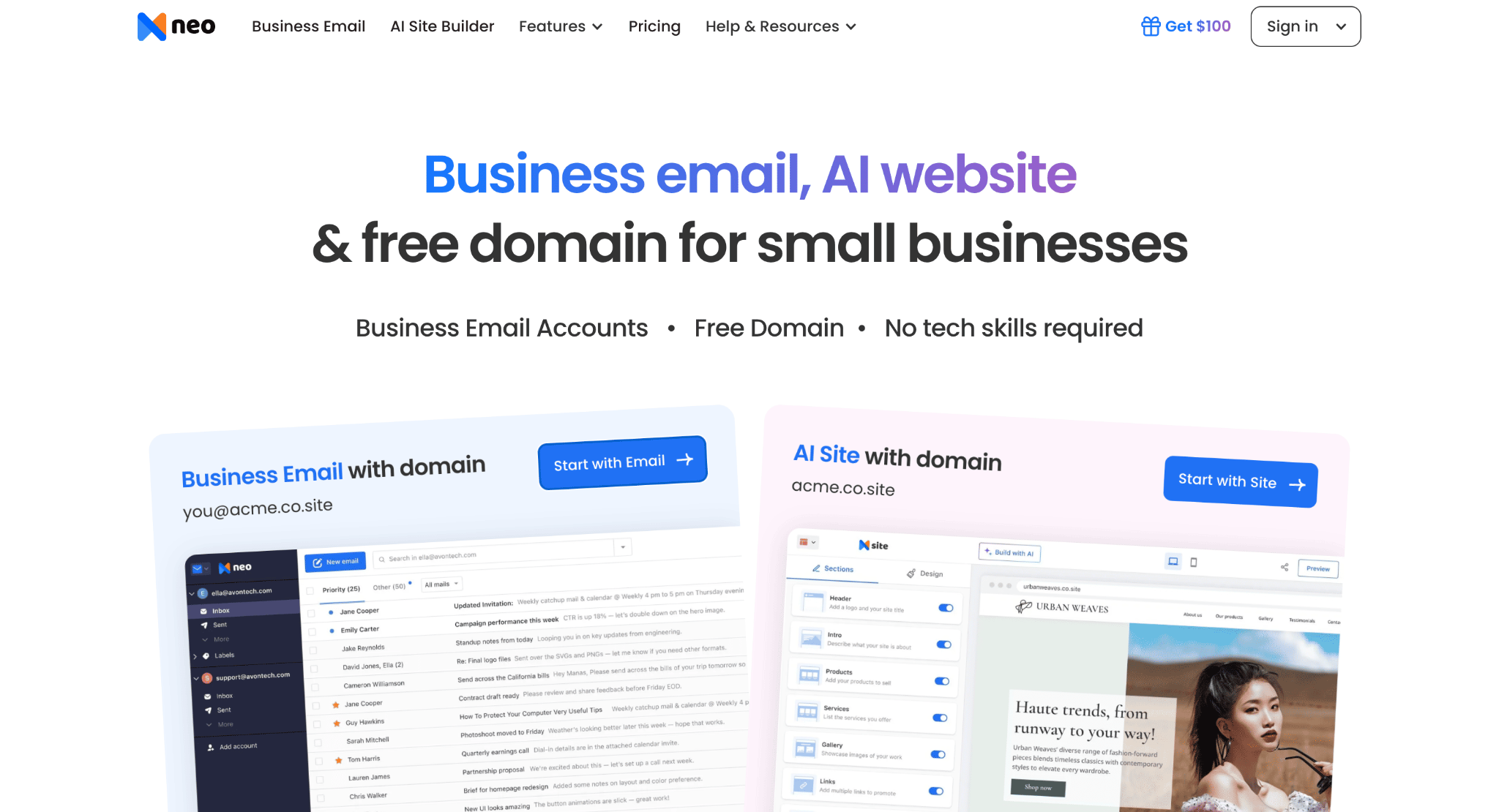
1. Start sign-up: Click Get Started on neo.space.
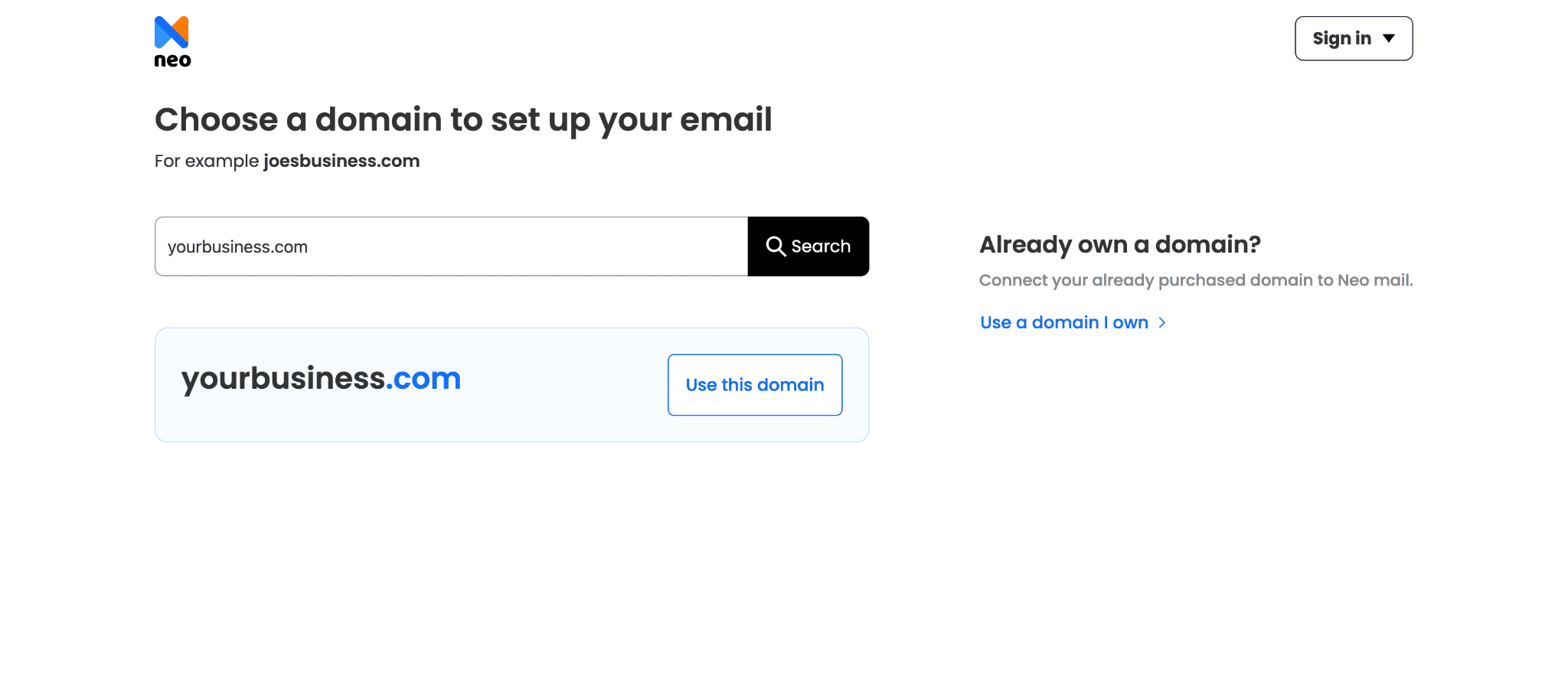
2. Choose your domain: Pick "I already own a domain name" to use yourbusiness.com, or "I need a new domain name" to get one free.
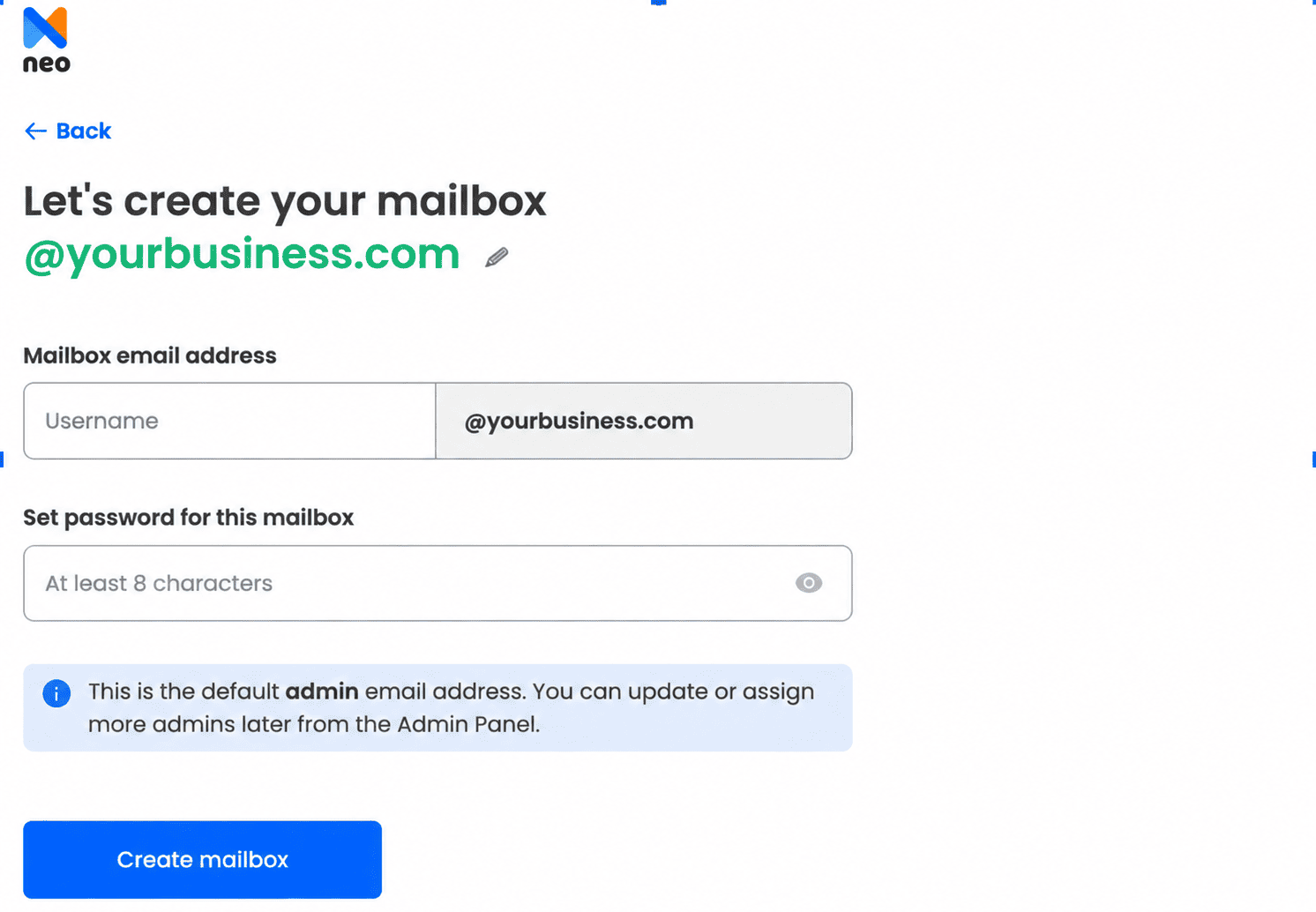
3. Create your first mailbox: Set up finance@yourbusiness.com as the main finance inbox.
4. Point your domain to the new inbox: Update the MX records of a domain you already own. MX records tell the internet where to deliver your email.
5. Add the other finance addresses as aliases: In the Email Control Panel, open Email Accounts, choose Manage alias, and add invoices@yourbusiness.com or billing@yourbusiness.com.
Each mailbox can hold up to 10 aliases, so one inbox can cover every address a small finance team needs (Source: Neo Mail Help Center).
A new finance address also becomes a target for invoice fraud from its first day.
You protect a finance email address by confirming payment changes by phone and limiting who uses the inbox. Business email compromise is a scam where criminals pose as a vendor or boss to redirect payments. Finance inboxes hold the payments, so they draw these attacks. The FBI's 2025 Internet Crime Report lists over $3 billion in business email compromise losses in 2025, second only to investment fraud.
One admin on Reddit's r/sysadmin described an accounting team that paid a fake invoice. The only clue was one missing letter in the vendor's domain. Other scammers pose as contractors and ask to "update" bank details before payday. Use this checklist for every finance address:
- Confirm bank changes by phone: Call a number you already have.
- Turn on two-factor authentication: A stolen password alone can't open the inbox.
- Limit access: Only people who act on payments read the inbox.
- Check the sender's domain letter by letter: Look for swapped or missing letters.
- Set up SPF, DKIM and DMARC: These DNS records prove your emails come from your domain.
The FTC also tells small businesses to set clear approval steps for invoices. Neo Mail includes two-factor authentication and custom DKIM on every plan. Our guide to adding a DMARC record covers step 5.
FAQs
What Email Address Should I Send Client Bills From?
Send client bills from billing@yourbusiness.com, so replies reach the person who owns billing. Never send bills from noreply@yourbusiness.com, because customers need to answer with questions or payment details. Using one billing address also trains customers to spot fakes that come from anywhere else.
Should a Small Business Have a Separate Email Address for Invoices?
Yes. A separate address such as invoices@yourbusiness.com keeps vendor bills out of the owner's personal inbox. Your accountant gets one place to find every bill. For a small team, the address can be a free alias rather than a paid mailbox.
What Is an Example of an Account Email Address?
An example of an account email address is accounts@yourbusiness.com, a general contact for balances and account questions. It differs from ap@yourbusiness.com, which only receives bills to pay. It also differs from ar@yourbusiness.com, which only tracks money customers owe. Small businesses often start with accounts@yourbusiness.com and split it later.
Who Should Have Access to the Company Finance Email Address?
The bookkeeper, AP clerk and finance lead should have access, and nobody else. An outside accountant should get only accounting@yourbusiness.com, not the whole finance inbox. Separate logins show who sent each reply, which matters when a payment is disputed.
Which Email Provider Is Best for Financial Accounts?
For a business's finance addresses, Neo Mail is right for small businesses and Microsoft 365 for teams that share mailboxes. The setup matters as much as the provider: aliases, two-factor authentication and limited access. For personal bank and brokerage logins, many people keep a separate private address used only for money. Keep that address off public profiles.
Get Business Email
No domain name required
Get Finance Email Address
Email with Free Domain & Site
